Summary
- In Singapore, teeth whitening options include in-clinic treatments (dentist, LED, laser) and at-home methods (custom kits and OTC products).
- Professional, in-clinic whitening is supervised by a dentist and uses clinically approved whitening agents to deliver visible results.
- LED and lasers can aid the whitening process by activating the gel, while at-home kits from dental clinics provide gradual, controlled whitening.
With several types of teeth whitening treatments available in Singapore, choosing the right one can feel overwhelming. Ahead, we break down what each option involves, how effective it is, and which may suit your condition. We’ll also cover how much teeth whitening costs in Singapore.
Table of Contents
ToggleCommon Causes of Tooth Discolouration
Not all stains are the same, and understanding the difference matters when you’re choosing the right teeth whitening treatment. The gradual yellowing from years of drinking coffee, for instance, has a different cause (and solution) than the deeper discolouration that comes with ageing.
Extrinsic Staining
Extrinsic stains sit on the surface of your teeth. They form when pigments from food, drinks, and other external sources settle on your enamel, or within the pellicle, which is the thin film that coats it.
Here are the common causes of extrinsic stains:
- Coffee, tea, and red wine
- Dark sauces and heavily pigmented foods
- Tobacco products
- Certain mouthwashes, like chlorhexidine, can react with compounds on the tooth surface and cause staining
- Poor oral hygiene, which allows plaque and tartar (hardened plaque) to accumulate and discolour the teeth over time
Intrinsic Staining
Intrinsic stains go deeper. Pigment-causing substances become embedded within the enamel and dentine, which is the softer, naturally yellower layer beneath the enamel. This can happen during tooth development or after the teeth have erupted.
These are considerably harder to treat and may be caused by:
- Antibiotics like tetracycline, once commonly prescribed to children
- Excess fluoride (fluorosis), which can lead to white patches or brown mottling
- Ageing and tooth wear, as thinning enamel allows the darker dentine to show through
Other Causes
Some types of discolouration can also stem from:
- Dental decay, which can darken the affected tooth
- Certain filling materials, which may cause discolouration of the dentine over time
- Root canal treatments and the materials used during the procedure, which can cause internal staining
- Reduced saliva flow, which limits your mouth’s ability to wash away stains
- Genetics, as some people naturally have thicker or whiter enamel than others
Understanding the Different Types of Teeth Whitening Treatments
Walk into any dental clinic in Singapore, and you’ll find no shortage of teeth whitening options. Here are all the different types and how they typically work.
Professional Teeth Whitening by a Dentist
A teeth whitening session at a dental clinic in Singapore is a supervised procedure designed to ensure that whitening agents are applied safely and effectively.
At Brightside Dental, we typically begin with a check-up to confirm your teeth and gums are suitable for treatment. Here’s what you can expect:
- Your dentist starts with scaling and polishing to remove surface debris, so the whitening gel can sit directly on the enamel
- A protective barrier is placed over your gums to shield the soft tissues
- The whitening gel is applied in cycles to keep the process consistent and controlled
LED or Light-Assisted Whitening
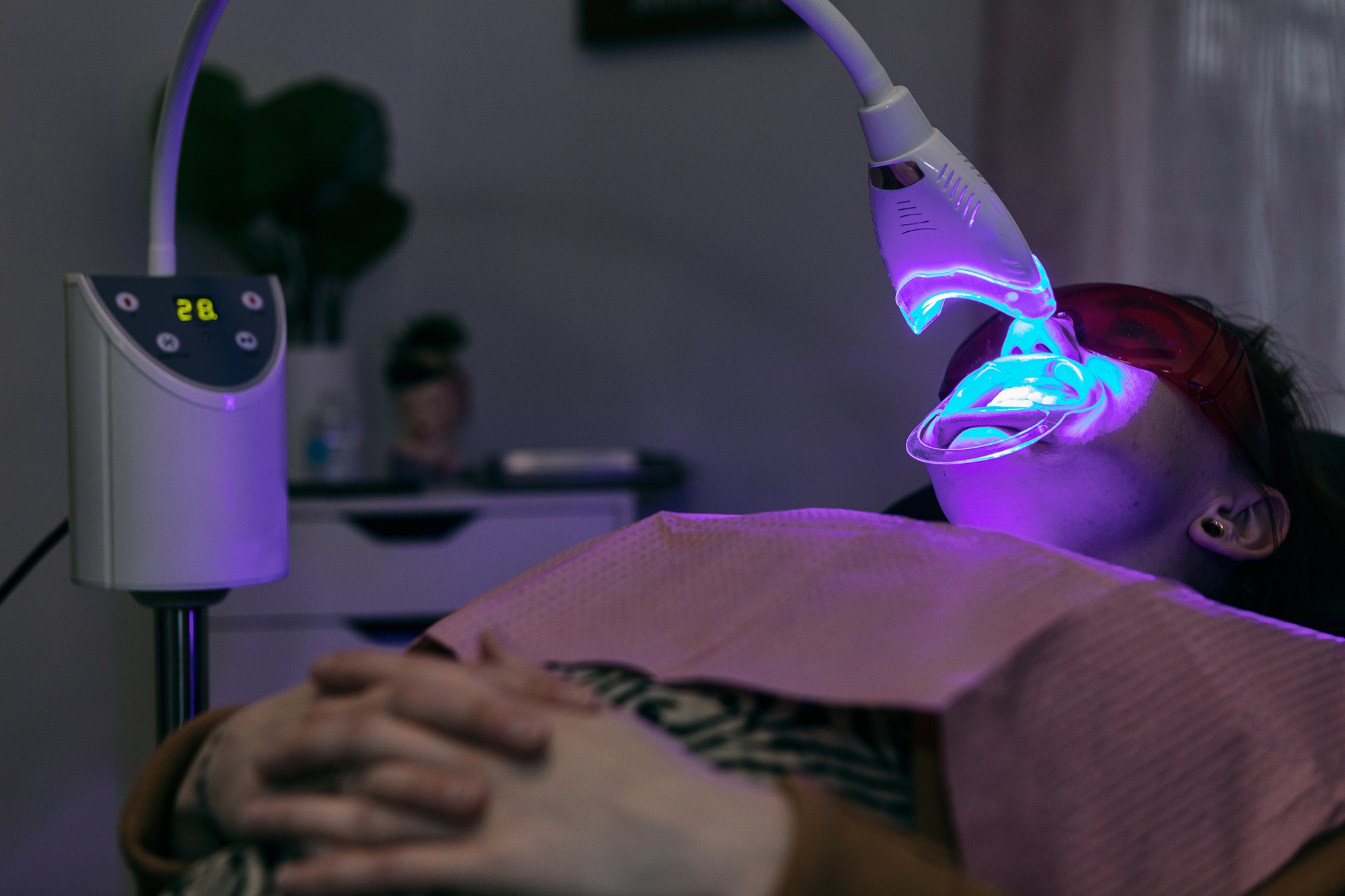
LED whitening is a common in-clinic method that pairs a whitening gel with a blue light source.
Once the gel is applied, an LED lamp is positioned over your teeth. The light acts as a catalyst, helping accelerate the chemical reaction within the gel so it breaks down stains more efficiently.
Because LED lights produce minimal heat, the process is designed to be comfortable while still delivering visible results.
Laser Teeth Whitening
Laser whitening works on a similar principle but uses a more concentrated light source.
After the whitening gel is applied, a calibrated dental laser is directed at the teeth to activate the formula. This encourages the active ingredients to break down stain molecules more quickly and deeply.
The treatment is typically completed in a single visit, with your dentist closely monitoring the process to ensure consistent and safe results.
At-Home Whitening Methods
At-home teeth whitening kits are an alternative option for those who prefer to manage the process on their own. There are two main types:
- Dentist-Prescribed Kits: These use custom-made trays based on a mould of your teeth. You apply a professional-strength gel and wear the trays for a set period each day, usually over one to two weeks. The custom fit helps keep the gel evenly distributed while protecting your gums.
- Over-the-Counter (OTC) Products: These include whitening strips and paint-on pens available at pharmacies. They’re designed for convenience and a universal fit, but are not customised, and typically use a lower concentration. It should be noted that, without professional supervision, you may end up using these products incorrectly or choosing a brand that is ineffective.
Dentist Teeth Whitening vs LED vs Laser vs Whitening Strips
Choosing the right method depends on your budget, your timeline, and how stubborn your stains are. Here’s how different teeth whitening treatments stack up against each other:
Strength of Whitening Agents
The “strength” of a teeth whitening treatment is determined by the concentration of its active ingredients.
- Dentist Teeth Whitening: Uses professional-grade gels commonly ranging from 10% to 35% hydrogen peroxide. The higher the concentration, the deeper the bleaching agent can penetrate the tooth to break down stubborn staining.
- LED Whitening: Uses the same high-concentration professional gels (10% to 35%) as a dentist-led session, as the light is only an activator.
- Laser Teeth Whitening: Utilises the highest permissible concentrations of professional gel, often at the upper limit of 35%, to ensure there’s enough reactive material for the laser to activate.
- Whitening Strips: These are restricted to very low concentrations (usually 0.1% or less) for safe over-the-counter use, meaning they primarily interact with the very surface of the enamel.
Speed and Visibility of Results
How quickly you see a difference depends on the potency of the gel and whether an energy source is used to accelerate the process.
- Dentist Teeth Whitening: Typically requires a 60- to 90-minute appointment. Results are visible after the session as the high-concentration gel works through multiple cycles.
- LED Whitening: Designed for efficiency, the light helps the gel work faster. Most patients see a visible change in shade after the first visit, but this can also depend on their general dental health and the extent of their initial discolouration.
- Laser Teeth Whitening: The focused energy from this method tends to produce quick results but, as with the other methods, this can also depend on the condition of your teeth.
- Whitening Strips: These require patience. Because the peroxide levels are low, you usually need to apply them for 30 minutes daily over 10 to 14 days to see a visible change.
Effectiveness of Different Whitening Methods
Here’s how well the different treatments manage stains and how they interact with your existing dental work.
- Dentist Teeth Whitening: Can be used to address both extrinsic and intrinsic yellowing. While it reaches deep into the enamel, it does not alter the colour of synthetic materials of dental restorations such as crowns, veneers, fillings, or bridges.
- LED Whitening: Effective at breaking down organic stains. Because this method is more active, it’s often chosen for those who want to ensure a uniform brightness across natural teeth, though it may still result in a colour mismatch with existing restorations.
- Laser Teeth Whitening: Often considered effective for stubborn or intrinsic staining that has settled deeper into the tooth structure over many years.
- Whitening Strips: Limited to mild, surface-level stains from food and drink. These are less effective at reaching the curved edges or gaps between teeth, where strips may not adhere perfectly, which may result in an uneven or patchy appearance.
Book a consultation to get started with a professional assessment at Brightside Dental.
Teeth Whitening Cost in Singapore
The cost of achieving a brighter smile in Singapore depends on the level of professional involvement and the technology used.
Cost of Professional Teeth Whitening
A standard in-clinic teeth whitening session at Brightside Dental in Singapore is priced around $649. This includes a dental consultation, basic scaling and polishing to prepare the enamel, a one-hour triple-action treatment, and post-treatment care.
Cost of LED or Laser Whitening Treatments
An in-office LED or laser whitening treatment may cost around $800 to $1,500 per session.
Cost of At-Home Whitening Products
A take-home teeth whitening kit from Brightside Dental costs around $399, which includes a prescription-strength peroxide gel, custom-moulded teeth trays, a desensitiser to manage comfort, and a pre-treatment paste.
Safety Considerations and Possible Risks
While professional treatments are designed to be comfortable, you also need to be aware of the safety and risks of teeth whitening before starting your journey.
Tooth Sensitivity After Whitening
It’s common to feel a slight “zing” in your teeth after a whitening session. You may notice a sharp sensation or a dull ache, especially when drinking something cold or eating something hot.
This happens because whitening agents temporarily open up microscopic pores in your enamel to reach the stains beneath. With those pores open, the dentine, your tooth’s more sensitive inner layer, is briefly more exposed, which is what triggers that sensitivity.
This effect is typically temporary. Sensitivity usually peaks within the first one to two days and fades as your enamel naturally reseals.
At Brightside Dental, we apply a professional desensitising gel right after your whitening treatment to help soothe your teeth before you leave the clinic.
Gum Irritation From Whitening Agents
If the whitening gel comes into contact with your gums, it can cause mild irritation or what’s known as “chemical blanching,” where the gums appear white and feel slightly tender for a short time. You may also notice some redness or a mild stinging sensation.
This is more common with over-the-counter products, where the fit is not customised to your mouth, and the gel can spread onto soft tissue.
In-clinic, our dentists prevent this by applying a gingival barrier, a protective coating that shields your gums during treatment. If you’re using our take-home kit, custom-moulded trays help keep the gel exactly where it should be, along the surface of your teeth and away from your gums.
How Long Do Teeth Whitening Results Typically Last
The duration of results for professional and home whitening treatments can vary significantly depending on how you treat your teeth in the following weeks.
At Brightside Dental, our professional, in-clinic teeth whitening can provide results lasting for about 18 months, depending on your lifestyle habits and oral hygiene.
OTC whitening products may last for a shorter period, with surface-level results.
Maintaining Your Teeth Whitening Results
Your enamel is naturally porous, which means it gradually absorbs microscopic pigments from the foods and drinks you consume. Over time, that’s what causes staining to return.
But by following a few simple steps for the aftercare and maintenance of whitened teeth, you can extend that freshly whitened look.
Foods and Drinks That Can Cause New Stains
For the first 48 hours after a whitening session, your teeth are especially receptive to colour. During this window, it’s best to avoid strongly pigmented foods and drinks such as coffee, tea, red wine, cola, and berries.
If you do have darker drinks, use a straw where possible and rinse your mouth with water immediately afterwards.
A simple approach is to follow a “white diet”. Stick to lighter-coloured foods like white rice, chicken, fish, eggs, tofu, and cauliflower, which are less likely to stain your teeth while they’re still sensitive.
Oral Care Habits That Help Maintain Results
Good daily habits are also a good defence against tooth discolouration. Brushing twice a day and flossing daily aren’t just for cavities; they also remove the sticky film of plaque that acts like a magnet for food pigments.
If you let plaque sit on your teeth, it eventually hardens into tartar, which is much darker and can’t be brushed away at home.
When Touch-Up Whitening May Be Needed
Even with good habits, teeth whitening results are not permanent. Over time, some dullness will return. This is when you can consider touch-ups, which are generally safe to do whenever you desire.
At Brightside Dental, you have two teeth whitening options:
- At home: Use your custom trays for a short one- or two-night refresh
- In clinic: Schedule a quick touch-up during a routine dental visit
Staying ahead of staining with regular maintenance may be easier than starting the process from scratch again.
Choose the Right Teeth Whitening Treatment in Singapore
With various teeth whitening options available, the right choice comes down to your stain type, teeth sensitivity, and aesthetic goals.
We’ll help you assess what’s causing your discolouration and recommend a treatment that’s both effective and suitable for your teeth, whether that’s an in-clinic procedure or a customised take-home kit.